
SRCCC Discharge Release Paths
Stark Regional Community Correction Center serves eligible adult felons sentenced by Common Pleas Courts in Holmes, Stark, Tuscarawas, and Wayne Counties. It is a community-based correctional facility, often shortened to CBCF. That facility type provides structured residential programming as an alternative within the adult felony system. It is separate from the Sheriff’s jail and from ODRC prison custody, so neither the county jail’s booking record nor an ODRC prison profile automatically documents an SRCCC discharge.
A resident may complete the program and move into the community under the court or a supervising authority. A court can also modify the placement, respond to noncompliance, or direct another outcome. The official site describes four phases and a nominal 180-day program, but the timing is not a guaranteed release date. Progress depends on behavior, participation, and compliance. The SRCCC record shows whether the person completed or otherwise left the program, while the sentencing docket explains the legal result.
| Question | Correct source |
|---|---|
| Did the resident leave SRCCC? | SRCCC confirmation or existing discharge record |
| Why did the placement end? | Sentencing Common Pleas docket and SRCCC record |
| Does supervision continue? | Probation department, court order, or ODRC APA when applicable |
| Was the person sent elsewhere? | Court entry plus the receiving custodian |
Verify an SRCCC Discharge
Start with the court that imposed the placement. The name “Stark Regional” does not mean every resident has a Stark County case. Confirm the sentencing county, court case number, full name, and approximate admission or discharge period. Read the latest journal entries in order. A program-completion entry, community-control modification, violation, revocation, or transfer can change what “left SRCCC” means.
- Identify the sentencing Common Pleas Court among Holmes, Stark, Tuscarawas, and Wayne Counties.
- Match the person by full name, case number, offense, and known dates rather than relying on a name alone.
- Ask SRCCC whether an existing record shows completion, discharge, transfer, or another departure.
- Read the court entry that states the legal effect of that departure and any continuing community-control terms.
- If another custodian or ODRC supervision appears, verify status with that authority separately.
The Stark County release search overview helps distinguish jail, court, ODRC, federal, and immigration records. For SRCCC, the court-and-program chain comes first. An ODRC result becomes relevant only if the individual has a separate prison, judicial-release, parole, or post-release-control record.
SRCCC Release Records Contact
The official Stark Regional Community Correction Center is the direct source for its own program records and current contact information. Ask for an existing record rather than a new narrative. A focused inquiry can identify the resident, sentencing court, case number, approximate placement dates, and the specific item sought, such as a completion, discharge, transfer, or termination entry. Access can be limited by privacy law, court rules, and the requester’s authority.
Stark Regional Community Correction Center
4433 Lesh Street NE
Louisville, OH 44641
Phone: 330-588-2500
Service area: Holmes, Stark, Tuscarawas, and Wayne Common Pleas Courts
A court record and an SRCCC record do different work. The docket can show the sentence, community-control order, modification, violation, or termination. SRCCC can address whether its own record shows that the resident completed or left the program. When public access is restricted, a resident, authorized representative, or attorney may have a different process than a general member of the public. Do not ask staff to disclose another person’s sensitive treatment details.
SRCCC Pre-Release Program Phases
The program structure is central to understanding a potential discharge date. SRCCC describes Orientation, Life Skills, Community Transition, and Pre-Release. The later phase names can sound like a fixed countdown, yet the official material ties movement through the program to conduct, participation, and compliance. “Pre-Release” identifies a program phase. It should not be published as proof that a resident has already left or will leave on a guessed date.
- Orientation
- The opening phase in the official four-part sequence.
- Life Skills
- A structured program phase that follows orientation.
- Community Transition
- A later phase preparing for movement toward the community.
- Pre-Release
- The final named phase, still part of SRCCC’s program rather than proof of discharge.
The official site and resident handbook describe a 180-day program. That figure is useful as the program’s stated framework, not as a calculator for one person. Court action, compliance, and the facility’s own record remain necessary. A person may also have other cases or supervision duties that are not resolved merely because the SRCCC placement ended.
The SRCCC homepage identifies its adult regional role.
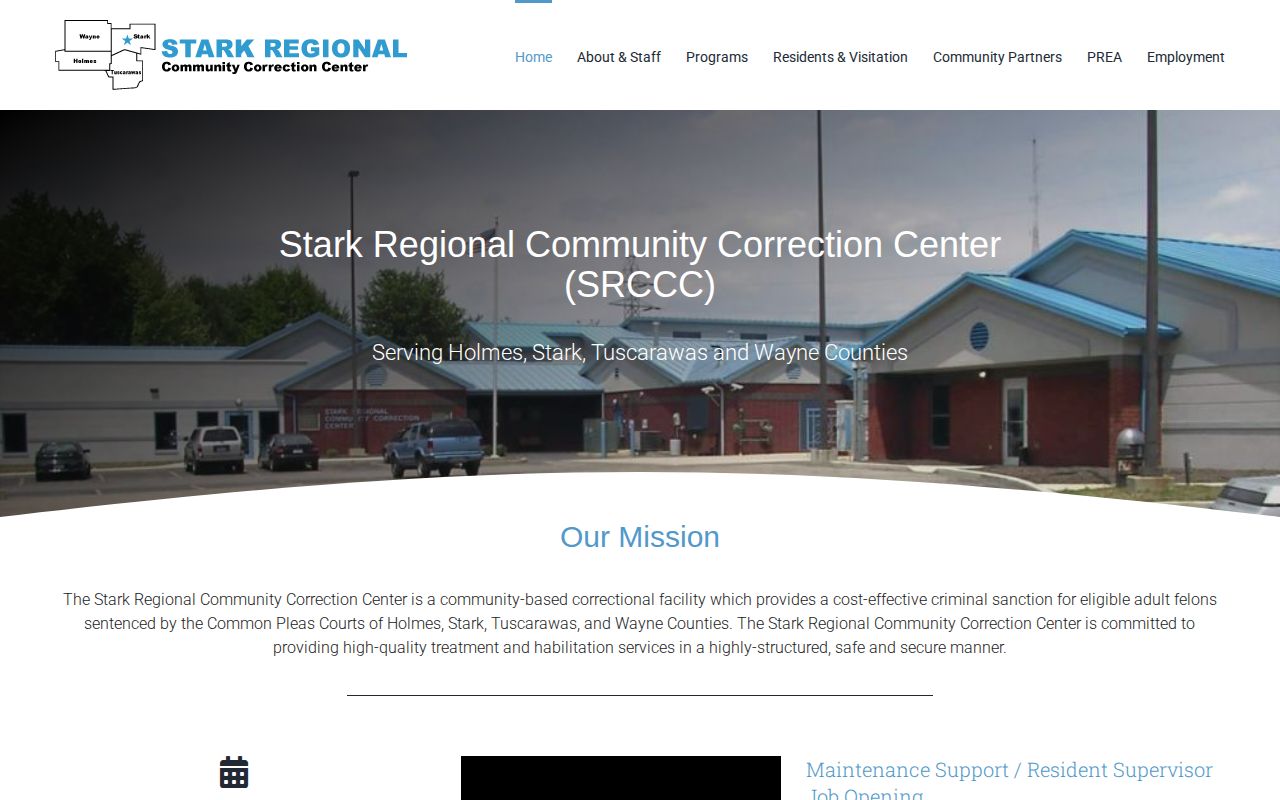
The official page confirms the facility identity and helps prevent it from being mistaken for the adult county jail or an ODRC prison.
SRCCC Court Supervision Records
SRCCC placement begins with a Common Pleas sentence, so the originating docket is the durable legal record. For a Stark County case, the Clerk links to StarkCJIS and its court search tools. Automated access may fail, making an ordinary browser search necessary. Use the case number whenever possible. Read signed entries rather than inferring status from a brief docket label.
Community control is Ohio’s court-supervised alternative to prison and is often called probation in ordinary speech. A docket may show the original terms, an SRCCC placement, later modifications, a violation allegation, revocation, or termination. Program completion and supervision completion are not the same event. Someone can finish the residential part yet remain subject to court conditions. Conversely, leaving before completion can lead to a court response that must be read from the record rather than guessed.
When ODRC’s Adult Parole Authority is named, check the statewide offender search under APA Supervision and compare the offender number, supervision start date, office, and conditions displayed. Do not label every SRCCC graduate as “on parole.” Many cases remain with local court probation, and the exact order controls.
Note: The sentencing county controls the docket search even though the regional facility itself is in Stark County.
SRCCC Discharge Versus Transfer
“No longer at SRCCC” is a narrow fact. It can describe successful program completion, a court-authorized change, removal after noncompliance, hospital movement, transfer, or another event. Public copy should use the exact term supplied by SRCCC or the court. If the record says transfer, name the receiving system only after it is confirmed.
Ohio VINE may help when a separate county-jail or ODRC custody record exists, but it is not a general SRCCC completion archive established by the research. The same limit applies to the Stark jail. A person may never appear there in connection with the SRCCC placement. Missing from either tool therefore does not establish program completion.
| Signal | What it proves | What it does not prove |
|---|---|---|
| SRCCC completion confirmation | The program reports completion | All court supervision ended |
| Court termination entry | The court ended the stated order | No other case or custodian exists |
| ODRC APA status | State adult supervision is recorded | Current residence or local jail status |
| Missing jail name | No match in the checked source | SRCCC discharge or community release |
SRCCC Release and ICE Holds
An immigration detainer or transfer matters only when it actually appears in the adult record. ICE defines a detainer as a request for notice and up to 48 additional hours so federal immigration authorities can assume custody. It is not an automatic feature of SRCCC discharge, nor is it proof that ICE took custody. The sentencing court, SRCCC record, and receiving agency must supply the event.
If the documented destination is ICE, use the ICE Online Detainee Locator after the SRCCC or local departure. The service can cover people currently detained and those released from ICE custody within its documented 60-day period. That later result answers a separate immigration-custody question. It should not be rewritten as a direct community release from SRCCC.
If there is no immigration signal in the record, do not inject one. Most verification remains with SRCCC, the sentencing Common Pleas Court, and the named supervising authority. Keeping the ICE path conditional avoids turning a possible interagency outcome into an unsupported claim about an individual resident.
Reconcile SRCCC Release Signals
Record the date and source of each check. Dynamic court and custody systems can change. If SRCCC reports completion while the docket has not yet posted a matching entry, describe the program report and note that court confirmation remains pending. If the docket modifies placement but SRCCC has not confirmed departure, report the court action without claiming that the resident physically left.
Identity must also remain exact. Common names can join two people by mistake, and the four-county service area makes the correct court especially important. Compare case number, full name, offense, sentencing county, and known dates. Avoid publishing private treatment information or turning a program phase into a custody conclusion.
Once the sources agree, state the result narrowly: completed SRCCC and remains on court supervision, discharged with supervision terminated, or transferred to a named custodian. That wording preserves the difference between residence, program completion, court supervision, and full discharge.