
Stark Projected Versus Actual Release
A projected date is a calculation or a parole-consideration point. An actual release is the event recorded when a custodian ends custody or transfers the person. ODRC labels its public field “Expected Release Date/Parole Eligibility Date,” which may mean Projected Release Date or Date Pending Parole consideration. Those are not interchangeable with the Parole or Release Detail.
Pretrial Stark County Jail custody is different. There may be no fixed date. Bond, dismissal, a court order, case progress, and another hold can affect the outcome. County-sentenced release timing belongs to the sentencing entry, jail-time credit, release order, and jail record. It is not calculated in the statewide ODRC profile unless the sentence resulted in ODRC custody.
A transfer can be an actual release from one facility without release into the community. Stark County Jail may send a person to ODRC, another county, an interstate custodian, or federal or immigration authority. Follow the destination in the release entry. The receiving agency then controls its own date and status.
Find Stark Projected Release Dates
Start with the custodian. ODRC covers Ohio prison incarceration, department supervision, and judicial release. Stark County Jail records cover local custody. A court docket supplies the sentence and legal orders but does not prove the exact moment a person walked out or that another agency did not take custody.
- Identify whether the person is pretrial, serving a county sentence, or serving an ODRC prison term. Note the case number and offender number when known.
- For ODRC, open the Ohio Offender Search. Search by the A, R, or W-prefixed offender number when possible, or begin with the last name.
- Match the full identity, Stark as County of Commitment when applicable, sentence, and status. Then read Expected Release Date/Parole Eligibility Date with any Parole or Release Detail.
- For Stark jail custody, read the sentencing or release-related court entry and request the booking/release record from the Sheriff.
- Check for another hold, transfer, court order, or APA status before treating any calculated date as final.
ODRC County of Commitment means the sentencing county, and only the first county in a multi-county record may be searchable or reported. Residential County applies to APA Supervision or Violators at Large and reflects the last recorded address. Neither filter turns ODRC into a county-jail history.
The full county, court, state, and federal fallback sequence appears in the Stark County release-record search.
Ohio Credit in Stark Release Dates
A sound estimate begins with the court's aggregate sentence and effective date. It then accounts for judicially determined jail-time credit, the corrections calculation, mandatory terms, concurrent or consecutive terms, and the earned-credit law that applies to the period of confinement. Only the custodian can provide the operative calculation.
For confinement on or after April 4, 2024, Ohio Revised Code 2967.194 governs eligible earned credit. An eligible person may provisionally earn one or five days per completed month of productive participation, with limited added credit for program completion. Ordinary aggregate credit is capped at 15 percent of the stated term. Specified completion awards can be 90 days or 10 percent, whichever is less. Eligibility and actual awards are not automatic.
Mandatory or nonreducible terms and several offense or sentence classes are excluded. Violations can cause credit denial or withdrawal. Earlier confinement may fall under former ORC 2967.193 and older implementing rules. That is why multiplying every sentence by 85 percent is wrong. The figure is only shorthand derived from one cap, not a universal Ohio rule.
Note: Earned program credit differs from jail-time credit for qualifying confinement before prison under ORC 2967.191 and OAC 5120-2-04.
Changes to Stark Release Dates
An expected date can move because the inputs or legal posture change. A past expected date does not prove the custodian failed to release someone. A future expected date also does not defeat an official status of RELEASED - Judicial Release. Compare the profile's current status, court order, and release detail before drawing a conclusion.
| Factor | Possible effect | Record to verify |
|---|---|---|
| Jail-time credit | Credits qualifying prior confinement | Sentencing entry and ODRC profile |
| Earned credit or loss | May shorten an eligible term or restore time after denial or withdrawal | ODRC calculation under the applicable statute |
| Consecutive or mandatory terms | Changes which time can be reduced and how terms combine | Court judgment and aggregate sentence |
| Judicial release | May end prison custody before the displayed expected date | Court order plus ODRC release status |
| Parole Board action | May grant, continue, defer, set, or rescind a parole date | Profile, Board order, or minutes |
| Detainer or transfer | Ends one custody while another custodian receives the person | Release entry and receiving-agency record |
Reagan Tokes non-life indefinite sentences also require care. Ohio law creates a rebuttable presumption of release at a minimum or presumptive earned early release date, with possible continuation subject to the maximum. That framework is not a promise of release on the minimum date.
Parole changes also resist a simple formula. A hearing result may say paroled, continued, referred to Full Board, deferred, or pending. Even a grant can carry a POA date, conditions, and processing steps. When the profile summary does not settle the point, request the Board determination or required-hearing minutes. Do not turn a hearing month into a release day.
Read Stark ODRC Date Fields
ODRC displays several dates with narrow meanings. Effective Sentence Date anchors the displayed sentence. Jail-Time Credit shows confinement credited through the sentencing and corrections process. Next Parole Board Hearing or Review Month schedules review, not release. POA Date is the earliest parole-on-or-after point. Supervision Start Date can show that release into APA oversight occurred.
Expiration of Supervision Term is the outer APA-control date, while Supervision End Date or Early Termination may show earlier completion. TC/TT Sentence Expiration concerns projected release from a halfway house in Transitional Control. A person in Transitional Control is still in a monitored placement and should not be described as fully discharged.
The official ODRC definitions screen pictured below explains PRD, POA, and other expected-release terms.
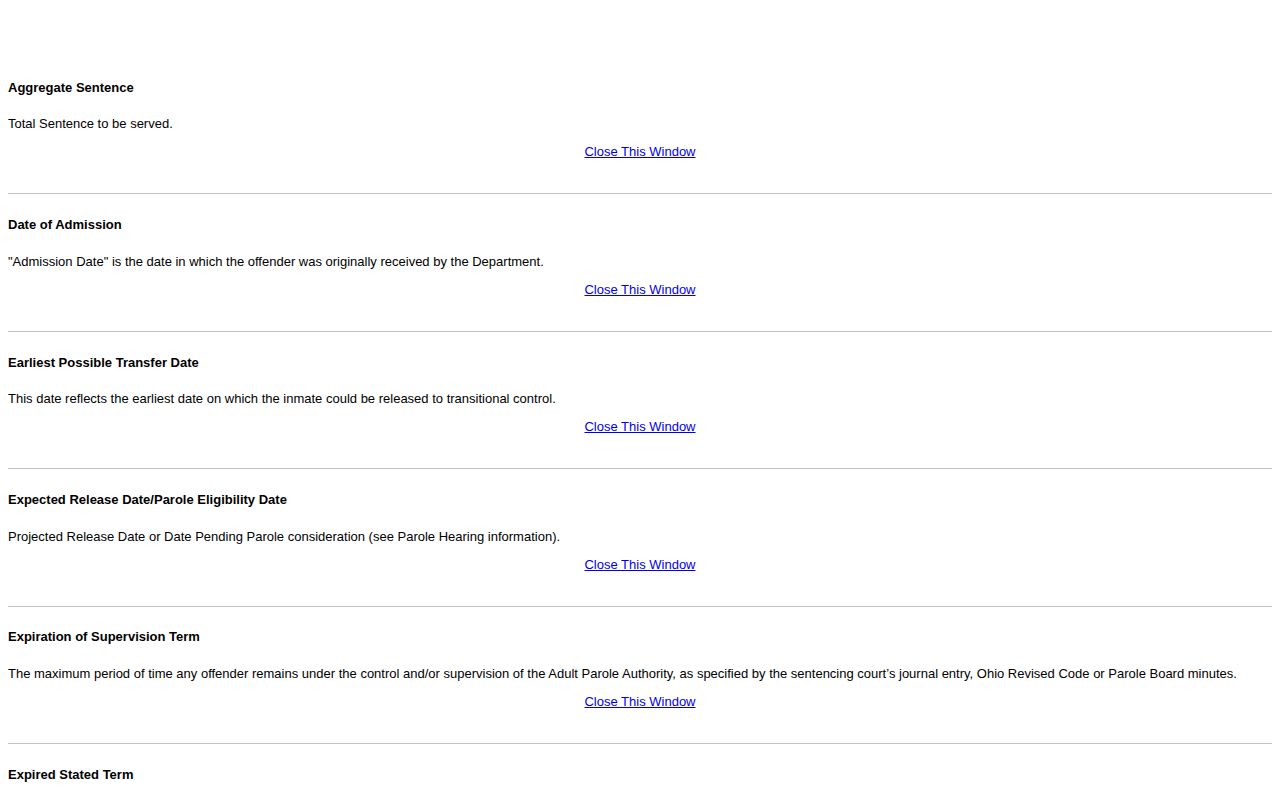
The source makes clear that one displayed date cannot answer every question about release, parole eligibility, or supervision.
An ODRC offender number uses an A, R, or W prefix plus six digits, with a possible leading zero for some women's numbers. Number search is safer than name-only matching. If only a name is known, begin broadly and then compare the photo, sentence, committing county, docket, judge, and offense details. A same-name record from another county should not supply a Stark County release date.
Two Ohio PRD Meanings
Ohio uses “PRD” in two related but distinct ways. In the public ODRC profile, Expected Release Date/Parole Eligibility Date is a calculated release or parole-consideration field. Under OAC 5120:1-1-10, the Ohio Parole Board may separately set a Projected Release Date after a denial.
A Board PRD is discretionary and may be rescinded. It creates no entitlement to release and is recorded in official minutes. The Board may instead schedule another hearing, generally within the rule's limit. Read the profile, latest hearing result, POA information, and official Board record as a set. Do not convert a hearing month or PRD into a fixed pickup time.
The image below comes from the official Parole Board projected-release-date rule captured for this page.
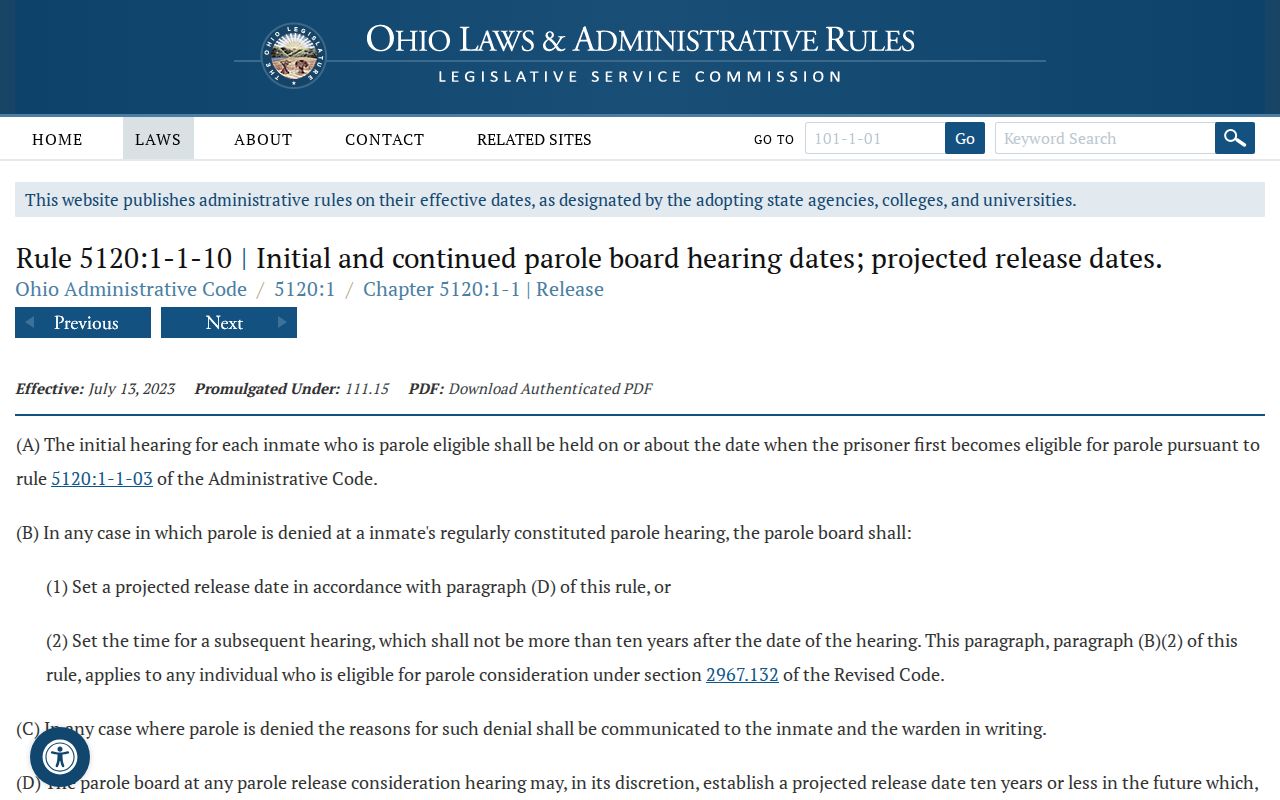
It supports the narrower Board meaning and the warning that a projected date remains subject to later action.
Note: A Board PRD is a discretionary parole decision point, while the public profile field may be a sentence calculation or eligibility date.
Missing Stark Names and Dates
No official Stark County browser roster or recent-release archive was verified. A missing name therefore cannot establish release. Ohio's state data adds another trap: an official profile can say RELEASED - Judicial Release while retaining a later Expected Release Date. Status and release detail take priority for the question of whether ODRC custody ended.
When signals conflict, use the creator of each record. The Sheriff establishes the exact end or transfer from Stark County Jail. The court establishes the legal order. ODRC establishes prison and APA status. VINELink supplies a corroborating notice. If a date is needed for planning, keep it labeled projected until the custodian confirms the actual release event.
A court order can precede jail processing. Another case, warrant, or detainer may also prevent immediate departure. Report the order and the pending verification as separate facts instead of assigning an unsourced Stark County release time.
Confirm Stark Inmate Release Dates
For a county-jail sentence, request the booking/release entry with the person's identifiers, date range, case number, release date and time, release manner, authority, and transfer destination. The Sheriff is at 4500 Atlantic Boulevard NE, Canton, OH 44705, telephone 330-430-3800. No posted Stark jail good-time formula, weekend-release rule, public release schedule, or dedicated release-record form was verified.
For ODRC, ask Central Records when the profile is unclear. VINELink can provide a pending custody-event alert, but its General Release event does not state the legal manner and should be followed by the source record. Registration details are covered on the Stark County VINELink release check. For a transferred person, continue to the receiving custodian because release from Stark or ODRC may not mean community release.
ODRC Central Records receives mail at P.O. Box 430, Columbus, OH 43216. A focused question should identify the person and offender number and ask which displayed date applies, whether the person is in custody or under APA supervision, and whether a release detail is available. The office, not a public date calculator, can resolve later sentence adjustments or mixed mandatory and reducible terms.
Note: Record the date and time of each lookup because court, ODRC, and notification data can change after the first check.