
Stark County Three-Day Release Records
The mandatory source sweep found no official Stark County Sheriff page that publishes a 72-hour release list. The Stark County Jail Division explains that its booking clerks book and release people for law-enforcement agencies across the county. It does not expose a public browser roster, rolling three-day view, field list, photo archive, update cadence, or retention policy. Unofficial lists cannot be combined and presented as a county feed.
A three-day inquiry should be framed as a records range. State the first and last calendar date, identify the person and booking when known, and ask for the existing release or transfer entry. The court docket can explain whether bond, sentence completion, dismissal, or another order changed custody. Physical exit still needs the jail record. Another hold or a receiving agency may change the meaning of the event.
Check Stark County 72-Hour Releases
Start with the date range rather than a broad request for “everyone released.” A narrow request is easier to match to the Sheriff's Jail Information Management System. It also gives the office a clear way to find an existing record without creating a new report.
- Write down the three calendar dates, the person's full name, known aliases, booking date, and case number. Include another identifier if names may match.
- Search the originating docket through Stark Common Pleas or the proper Alliance, Canton, or Massillon municipal court. Read signed entries in order.
- Contact the Stark County Sheriff at 330-430-3800 and request the booking/release entry for that range.
- Ask for release date and time, release manner, releasing authority, holds, and transfer destination or receiving agency.
- Follow any named custodian. Use ODRC for an Ohio prison transfer, BOP for a federal sentence, or ICE resources for immigration custody.
Use the Stark County Released Last 24 Hours route when the question concerns today alone. That shorter process emphasizes rapid contact with the Sheriff.
Stark County Three-Day Record Fields
Because no official public list was found, there are no verified web columns to describe. The Sheriff's official material confirms internal booking, release, fingerprint, photograph, and property work. Request the following fields for each relevant stay, while recognizing that availability, exact naming, and any lawful redaction are decided by the records custodian.
| Field to request | Why it matters across 72 hours |
|---|---|
| Name, identifier, booking number | Separates similar names and multiple bookings in the range. |
| Admission and release timestamps | Places the custody event within the three-day period. |
| Disposition or release manner | Helps distinguish bond, sentence end, order, or transfer. |
| Releasing authority | Points to the court or agency record that supports the change. |
| Receiving agency or destination | Shows whether the person stayed in custody elsewhere. |
| Booking photograph | May help match the booking but must be requested separately. |
These are useful request terms, not a promise that every field exists under that label. Ask for the nonexempt remainder if part of a record is withheld. A transfer date belongs to the releasing jail; it is not an automatic community-release date.
Stark Weekend Release Verification
A three-day span is useful for a Friday-through-Sunday check or when offices and courts have different public hours. It prevents a search from being tied to one calendar day. Yet Stark County research found no official weekend or holiday early-release rule, no stated release door, no set release hour, and no online update schedule. The fact that the jail operates continuously only describes jail and booking operations.
Read the docket by event time, not merely by case status. A Friday bond order could precede jail processing or another hold. A dismissal in one count might coexist with a second case. A municipal felony filing can later appear in Common Pleas. For a named-person investigation, the Stark County released inmates record path shows how to trace those sources beyond a three-day window.
Build the range from the actual calendar dates. “Last 72 hours” can mean a rolling period measured from the current time, while a records office may interpret the request as three calendar days. State both the start and end date and, when timing matters, the approximate hour. Ask the Sheriff to identify the recorded timestamp rather than assuming that the time of a court order is the same as the time jail custody ended. This distinction is especially useful when an order, processing step, and transfer fall on different days.
Note: Record the time of each Sheriff, court, VINE, and locator check because dynamic custody information may change after the weekend.
Stark County Three-Day Fallbacks
Under Ohio Revised Code 149.43, request an existing booking/release sheet or event entry for the precise date range. Ask for electronic copies and a cost estimate when the volume is unclear. Ohio law generally provides prompt inspection during reasonable times and copies within a reasonable period, not a fixed number of business days. No dedicated Sheriff form, photo fee, or release-record timetable was verified. The Stark County Clerk's public-records policy illustrates local ORC 149.43 practice, including inspection, redaction, and requests for existing records. Its stated copy charge and office hours belong to the Clerk, not the Sheriff.
VINE works only when the user has found and registered for the specific custody record. Its “General Release” alert can support timing, but it does not identify the legal reason. ODRC Offender Search applies to state incarceration, judicial release, and state supervision. It does not fill the missing county-jail feed. A court docket explains the legal order, while the Sheriff entry proves the local transaction.
The Clerk policy is a useful source for the local records framework, with the Sheriff remaining the custodian for jail release data.
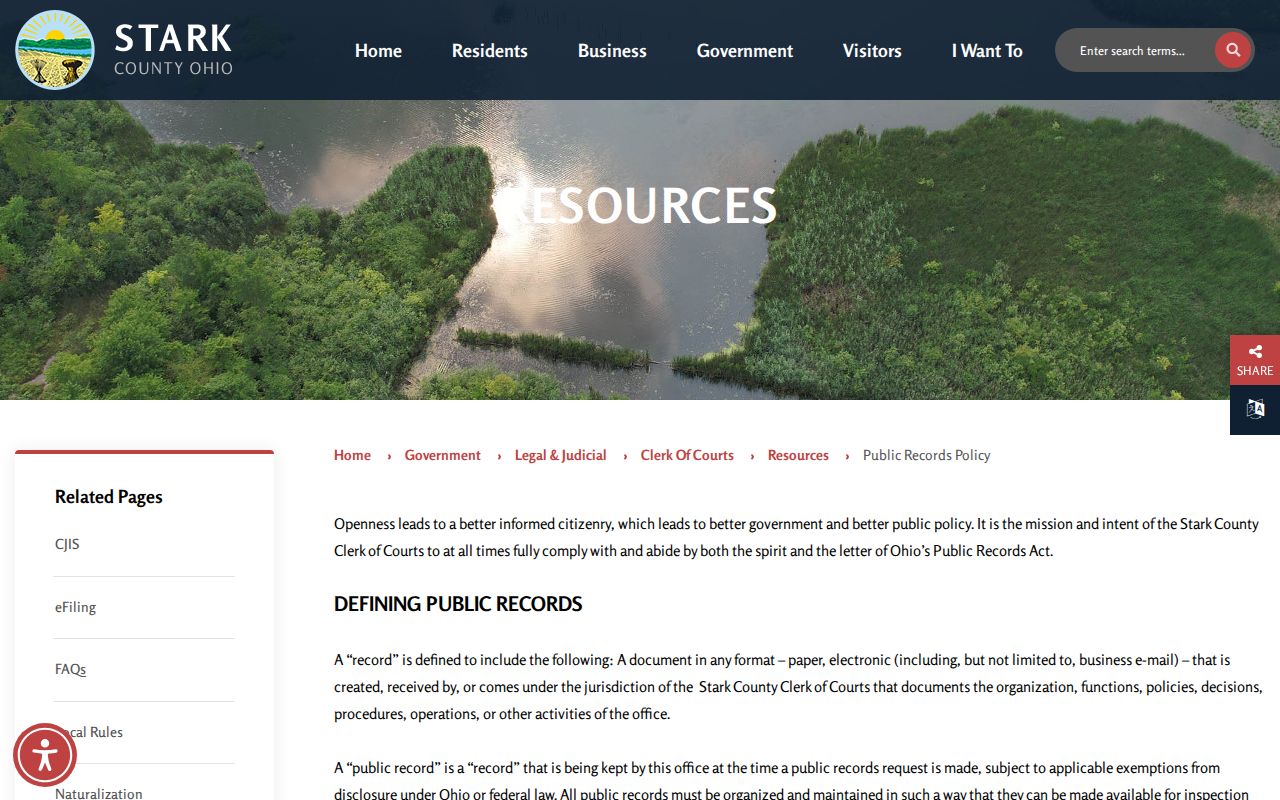
The captured policy reinforces requesting an identifiable existing record and allowing lawful redaction rather than expecting a custom three-day report.
Stark Release Data Can Conflict
No official public retention period was found for a Stark County release record. That means nobody can safely claim that a released person's name remains visible for exactly 24, 48, or 72 hours. Absence from a current source can result from release, transfer, spelling, data timing, or the lifecycle of the display. The originating Sheriff's entry is the strongest record for the end of local jail custody.
State records contain a separate quirk. An ODRC profile can show “RELEASED - Judicial Release” while also displaying a later Expected Release Date. The explicit status and release detail, sentencing-court entry, and ODRC record control the custody question. A calculated date is not enough by itself. Likewise, “APA Supervision” means prison custody ended while state supervision continued.
Conflicting signals should be stated narrowly. Say that the court issued an order, that the Sheriff recorded transfer, or that ODRC reports a released status. Do not merge those events into a claim that the person was in the community throughout the three-day window.
The receiving agency matters as much as the date. An ODRC transfer should be followed through the statewide offender search. Another Ohio county requires that county's jail record. A federal sentence belongs in the BOP locator, while USMS pretrial movement may instead require a federal docket or records request. Immigration custody has its own ICE locator. None of those sources turns into a Stark County 72-hour feed, but each can explain where custody continued after the local departure.
A three-day result also needs a clear endpoint. If the Sheriff entry shows release to the community, check the court record for any continuing conditions. If it shows transfer, record the receiving agency and begin a new custody check there. This keeps the Stark County departure separate from any later release by the next custodian.
- Released
- A named custodian's confinement ended. Supervision or another custodian may still apply.
- Transferred
- The person left one facility because another agency assumed custody.
- Expected date
- A calculated or parole-consideration field that can differ from the actual release event.
- APA supervision
- ODRC community oversight after prison custody, not an ordinary county-jail status.
Note: A 72-hour release range offers broader timing context, but only the responsible custodian can confirm the final event and destination.