
Indian River Youth Release Paths
Indian River Juvenile Correctional Facility is operated by the Ohio Department of Youth Services, or DYS. Official oversight material describes a higher-security setting with individual cells for youth ages 12 through 20 and a design capacity of 165. Those figures describe the youth facility. They must not be converted into adult inmate statistics, current population claims, or release totals.
A departure can mean DYS release, movement to aftercare, a juvenile-court disposition, or transfer to another youth setting. Aftercare is support or oversight that follows institutional placement. Transfer ends custody at Indian River but does not mean the youth returned to the community. The DYS record and juvenile authority establish the destination and status. Stark County Jail’s adult record and ODRC’s adult offender profile do not.
| Indian River outcome | Confirmation source |
|---|---|
| DYS release to community or guardian | DYS and responsible juvenile authority |
| Move to youth aftercare | DYS aftercare or case contact |
| Transfer to another youth facility | DYS transfer record or authorized confirmation |
| Court-directed change | Responsible juvenile court through permitted access |
The key is to name the custodian. “Released from Indian River” addresses one facility. It does not prove that all DYS authority, court oversight, placement, or services ended.
Verify Indian River Youth Release
Begin with the caller’s authority and the youth identifier used by DYS. Public disclosure can be restricted, so a parent, guardian, attorney, or other authorized participant may have access that a general caller does not. Keep identifying facts inside the official exchange. Do not post a youth’s name, photograph, birth date, ID, or placement question into an adult or commercial search.
- Open the official DYS Indian River facility page and use its current contact route.
- Ask what proof of relationship or authority is required before sharing youth information.
- Provide the youth ID only through the channel DYS directs.
- Confirm whether the event was release, aftercare, court disposition, or transfer.
- Contact the responsible juvenile court or receiving youth authority when DYS directs further verification.
An authorized status answer should be recorded in the exact terms given. If DYS says transfer, do not call it community release. If the court reports an order but DYS has not confirmed the physical move, state only that the order exists. Timing and transport can cause those signals to differ for a period.
Indian River Release Contact
The official Ohio DYS Indian River page is the starting source for current facility contact instructions. The research confirms the street address but does not provide a verified facility telephone number or public records hours. Use the official page rather than guessing a number, borrowing an ODRC adult prison contact, or applying Stark County Sheriff records procedures.
Indian River Juvenile Correctional Facility
Ohio Department of Youth Services
2775 Indian River Road
Massillon, OH 44646
Contact: Use the official DYS facility page
Record type: Restricted youth custody and release information
Ask first for the process available to an authorized person. DYS may direct the inquiry to a case contact, facility office, youth records channel, aftercare authority, or juvenile court. A public caller should expect limits. The lack of a public response cannot be converted into a custody conclusion, and an agency is not required to create a new narrative simply because someone asks a broad question.
The facility’s identity and youth-system role are visible on the DYS source page.
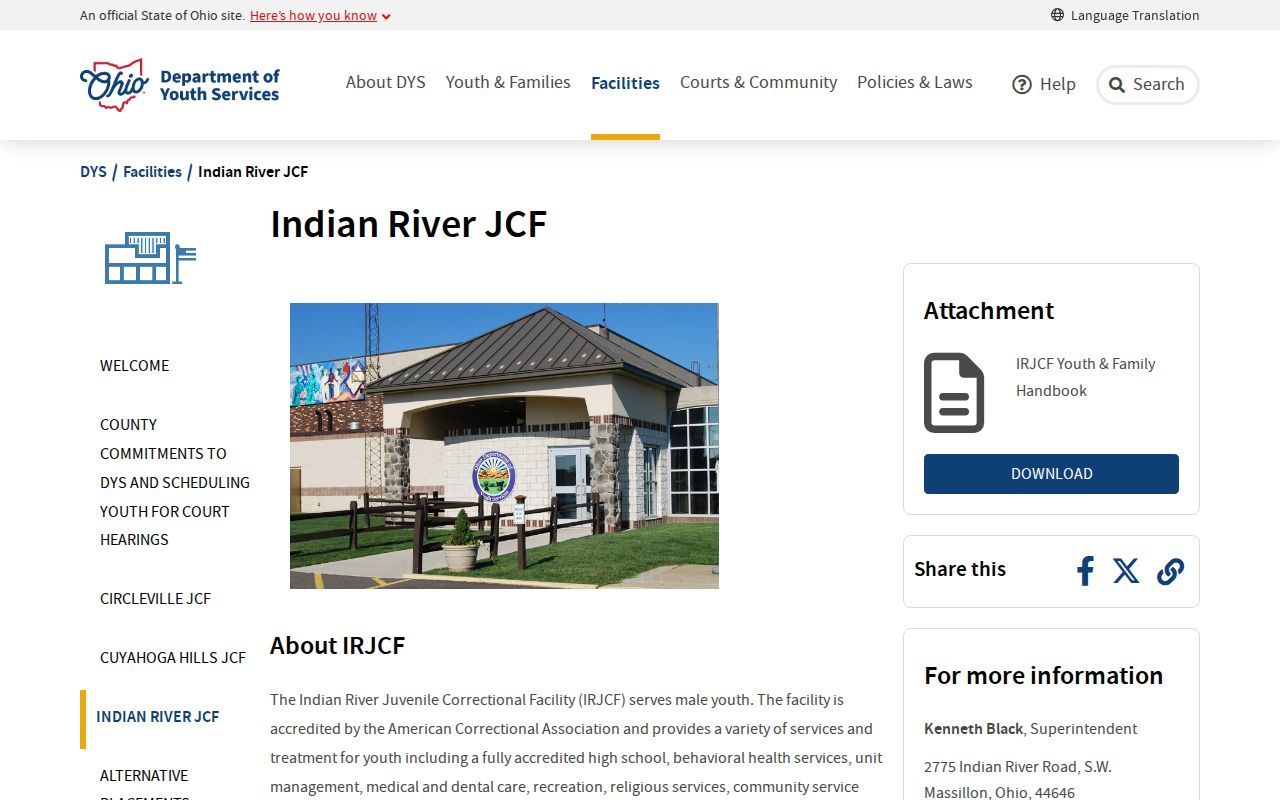
The official image anchors the record to DYS and helps prevent the common error of treating Indian River as an adult ODRC institution.
Indian River Is Not ODRC
ODRC is the Ohio Department of Rehabilitation and Correction. Its public offender search covers adults currently in Ohio prisons, adults under Department supervision, and judicially released adult offenders. Indian River is run by DYS. The two departments serve different populations and maintain different records. An adult ODRC “Released,” “APA Supervision,” or expected-release field does not establish a youth’s Indian River status.
| Source | Population | Indian River use |
|---|---|---|
| DYS | Ohio youth custody and aftercare | Primary agency route |
| Juvenile court | Youth case orders and placement | Use through authorized process |
| ODRC offender search | Adult prison and APA records | Do not use for Indian River |
| Stark County Jail | Adult county custody | Does not confirm DYS status |
| BOP locator | Federal sentenced custody | Does not control youth DYS records |
This distinction also affects terminology. “Parole” and “post-release control” on an ODRC adult profile should not be copied into an Indian River youth record. Use the terms supplied by DYS and the juvenile court, such as aftercare, transfer, placement, or release, and define them in context.
Note: Indian River’s location in Stark County does not make the Stark County Sheriff the custodian of its youth records.
Indian River Youth VINE Route
Ohio’s detailed official VINE brochure states that the service covers ODYS and gives a youth-specific method: registration is phone-only and requires the youth ID. That differs from the ordinary adult online search flow. Because the brochure was revised in 2015, an authorized caller should confirm the live steps rather than assume that every old interface detail remains unchanged.
The published Ohio VINE number is 1-800-770-0192, with TTY service at 1-866-847-1298. The current Ohio Attorney General VINE material says victims and concerned citizens may use VINE for custody-status notifications and warns against relying on it as the sole safety source. For Indian River, the youth ID and phone-only limitation are central. Do not attempt to stage or publish a youth result.
- Youth ID
- The DYS identifier required by the official youth notification instructions.
- Notification
- An alert that a reporting source sent a custody event, not a certified release record.
- Aftercare
- Youth-system support or oversight that may follow facility departure.
- Transfer
- Movement to another youth custodian rather than community release.
The official Ohio VINE brochure supplies the older youth-specific instructions. A notification must still be followed with DYS or the juvenile authority when exact release manner matters. The event cannot, by itself, explain whether the youth returned home, entered aftercare, moved to another facility, or remained subject to court direction.
Indian River Record Confidentiality
Ohio public-record rules do not make every field in a government system public. Juvenile, medical, victim, security, and other protected information can require withholding or redaction. Indian River’s youth status makes adult booking-sheet assumptions especially unsafe. No public roster, public booking-photo archive, or adult-style release-field inventory is established for this facility.
A lawful inquiry should seek only what the authorized person needs and may receive. The first question is procedural: which office handles the matter and what authority must be shown? If DYS directs the requester to a juvenile court, case contact, or counsel, use that channel. Do not try to reconstruct the answer from social media, commercial pages, or unrelated adult records.
The Stark County release-system overview separates the four local facility types. For Indian River, it reinforces that the state youth agency controls release and transfer information even though the facility sits in Massillon.
Indian River ICE Release Limits
An adult Stark County Jail release can sometimes become an ICE transfer. That possibility does not establish an Indian River process. ICE’s public Online Detainee Locator does not permit searches for people under 18, and adult immigration tools must not be presented as the way to confirm a DYS youth release.
If immigration authority is involved in a particular youth case, an authorized participant should work through the juvenile court, counsel, DYS, and the official federal contacts supplied for that matter. Public copy should not expose the youth’s A-number, birth date, location, or status. The adult ICE rule about a detainer request and up to 48 additional hours cannot simply be mapped onto a state youth placement.
Likewise, the ICE resource’s 60-day scope for certain people released from immigration custody answers only an ICE question. It does not prove when a youth left Indian River, whether DYS transferred the youth, or whether juvenile aftercare continues. The youth authority remains controlling.
Reconcile Indian River Release Records
Conflicts should be described, not forced into a single unsupported claim. A court order can precede physical movement. DYS may confirm a transfer while a family uses “release” in a broad sense. A VINE notice can report a source event without explaining its legal basis. The source with custody of the youth is best placed to confirm the physical change, while the juvenile court explains its order.
Keep a record of the date, channel, and exact language of an authorized response. Dynamic information can change, and youth privacy may limit what can be repeated. If the only result is that public access is unavailable, that is the correct public conclusion. It is not a reason to infer current custody or departure.
The final wording should remain narrow: DYS confirmed release to an authorized party, DYS confirmed transfer, or the juvenile court entered a stated disposition. That approach respects confidentiality and preserves the difference between leaving Indian River and ending every youth-system obligation.