
Stark Parole Versus Probation
Parole follows release from an eligible prison sentence after action by the Ohio Parole Board. Post-release control is another form of state supervision that follows qualifying prison terms. Both may be administered by the Ohio Department of Rehabilitation and Correction's Adult Parole Authority, or APA. Probation in an Ohio court is often called community control. It is imposed by a judge instead of, or after a reduction of, confinement and may be tracked in Stark County Common Pleas or a municipal court docket.
The label matters. An ODRC result that only says “Released” should not be described as parole. Look for APA Supervision, a supervision start date, an APA office, or parole/release detail. A court order placing someone on community control points to probation even if no APA result appears.
A person can also move from prison to APA supervision while facing a later local booking. Both records may be accurate. The ODRC profile answers the continuing state obligation, and the Stark jail entry answers the new local custody. Likewise, successful completion of one case does not end supervision imposed in another case. Match each status to its case, court, and custodian before calling it a discharge.
| Supervision type | Who authorizes it | Best Stark County check |
|---|---|---|
| Parole | Ohio Parole Board for an eligible prison term | ODRC profile, parole result, and Board record |
| Post-release control | Ohio law and sentencing judgment after prison | ODRC APA status and court judgment |
| Probation or community control | Stark County Common Pleas or municipal court | Sentencing docket and supervising court |
- Discharge
- The formal end of a custody or supervision obligation.
- Absconder
- A supervised person whom ODRC lists as having stopped required contact.
- Judicial release
- A sentencing court's order shortening prison confinement, often with court-set conditions.
Verify Stark Post-Release Supervision
Begin with the sentence, not the person's absence from a jail roster. ODRC covers people incarcerated in Ohio prisons, under department supervision, or judicially released. It is not a Stark County Jail archive. Local probation may exist only in a court file. A name, case number, and ODRC offender number help prevent a same-name match.
- Open the ODRC Offender Search. Search by offender number when known, or begin with the last name.
- Select “APA Supervision” to narrow active state supervision. Check the full name, offender number, committing county, and sentence details before accepting a match.
- Read Supervision Start Date, Period of Supervision, APA Offices, Conditions of Supervision, and Parole or Release Detail when those fields appear.
- Search the proper Stark court docket for community-control, judicial-release, revocation, or termination entries. A felony may start in municipal court and continue in Common Pleas.
- Confirm an unclear result with the listed APA office, the sentencing court, or ODRC Central Records. Ask for the exact status and whether supervision has been discharged.
A Stark County release record establishes departure from a particular custodian. It does not replace the supervision record. The broader Stark County released-inmate search path explains how to pair the jail entry with a court order and any receiving agency.
Note: Residential County and ZIP in an APA result reflect the last recorded information and should not be treated as a live address.
Stark Supervision Record Contacts
The public ODRC profile may name an APA office tied to the record. Use that displayed office for a person-specific status question. Research did not establish a single local street address or office hour that applies to every Stark supervision case, so the profile is the safer routing source. ODRC Central Records can address state status records. Ohio Parole Board records are a separate route when minutes or an official determination are needed.
ODRC Central Records
P.O. Box 430
Columbus, OH 43216
Find the listed APA office in Offender Search
Ohio Parole Board
4545 Fisher Road, Suite D
Columbus, OH 43228
Probation questions follow the sentencing court instead. Stark has Common Pleas plus Alliance, Canton, and Massillon Municipal Courts. Read the case history to identify which court issued community control and any later termination or revocation. A docket order is legal proof of what the court did, but a custodian record is still needed to establish the physical release time.
Ohio Revised Code 149.43 supports prompt inspection and copies within a reasonable period, but parole, probation, and post-release-control proceedings may contain exempt material. Ask for a specific determination, order, minute, or status record. If part is withheld, request the nonexempt remainder and the cited legal authority. A focused request is more likely to reach the right record than a demand for an entire supervision file.
Stark Parole Hearing Records
ODRC Offender Search also functions as Ohio's practical parole-hearing calendar. Enter a year and month in YYYYMM form under “Next Parole Board Hearing Date.” An individual profile may show the next review month plus the latest hearing type and result. A First Hearing is an initial review. A Continued Hearing means another review will occur later. Full Board referral and a projected release date are distinct outcomes, so the result should be repeated in the Board's own terms.
A “paroled” result does not prove the person has already walked out. A parole-on-or-after date, conditions, and release processing can remain. When the profile summary is unclear, request the determination, order, or required-hearing minutes from the Ohio Parole Board. Ohio administrative rules make those records public, while decision sheets may receive a written access review and redaction for safety, security, or fair-hearing concerns.
The official Violators at Large listing pictured below shows the narrower ODRC route for at-large supervision records.
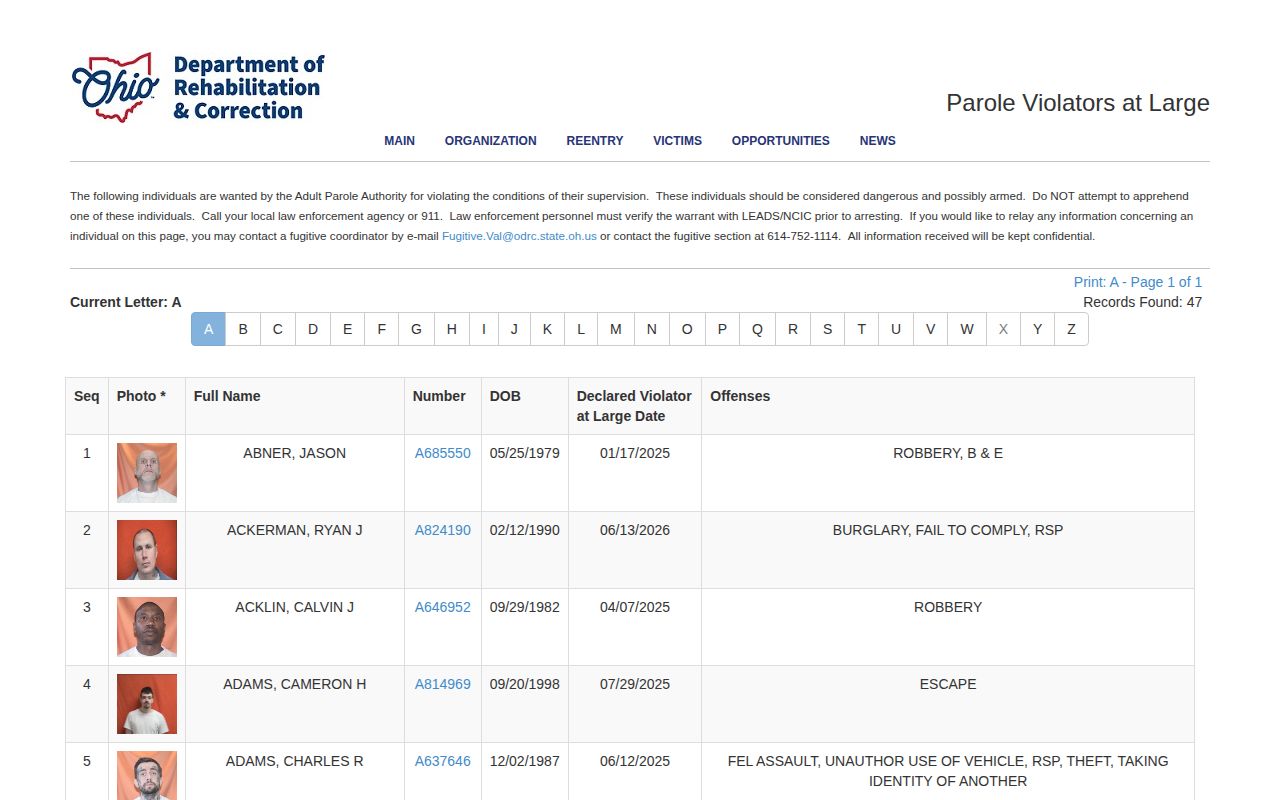
This screen should be used to confirm ODRC's listed status, not to infer a person's present location.
Stark Absconder Status and Warrants
ODRC provides both a Violators at Large filter and an alphabetical VAL list. A listed person is an absconder under the state's supervision system. This is not the same as a normal discharge, and the residential field is not a current tracking tool. Ohio Revised Code 2967.15 states that time at large does not count toward the sentence or post-release-control period.
Do not try to locate or approach a listed person. Report relevant information to the named APA office or law enforcement. A court docket may also show a warrant or revocation matter, but the ODRC record answers the state-supervision status. VINE can send custody-event alerts for a registered inmate record, yet it is not a warrant search and should not override an agency's corrected status.
Stark SRCCC Discharge Supervision
Stark Regional Community Correction Center creates a local distinction that a general parole search can miss. SRCCC is a community-based correctional facility serving Common Pleas Courts in Stark, Holmes, Tuscarawas, and Wayne Counties. It is neither Stark County Jail nor an ODRC prison. Its program is described as lasting 180 days and moving through Orientation, Life Skills, Community Transition, and Pre-Release.
That duration is not a guaranteed discharge date. Progress depends on conduct, participation, and compliance. Confirm a Stark participant's completion or other departure with SRCCC and the sentencing or supervising authority. Then read the court docket for the legal result. A person who left SRCCC may be under probation, another form of community supervision, or a new court order. Their absence from the county jail roster says nothing about program completion.
Note: SRCCC discharge should be described from its own record and the sentencing docket, not relabeled as a county-jail release.
Property After Stark County Release
Supervision records do not resolve personal property left at the jail. Stark County Sheriff Inmate Services expressly handles prisoner-property releases and property left behind. The official source does not publish a final-release pickup location, schedule, or retention period. A released person or an authorized contact should call the Sheriff at 330-430-3800 for current instructions before traveling.
This is separate from APA or probation property rules. The jail controls items inventoried during Stark County Jail intake. A transfer to ODRC or another custodian can also affect what traveled with the person. Ask which office now holds the item, what identification or authorization is required, and whether the release entry shows a property disposition. Those details should come from the office, not from an assumed routine.
Confirm Stark Supervision Discharge
Supervision ends through an official discharge, expiration, early termination, or another order that applies to the specific case. ODRC fields can include Expiration of Supervision Term and Supervision End Date or Early Termination. The first is the outer date of APA control. The second may document an earlier completion. A past expected prison release date is not a substitute for either field.
For probation, find the termination entry in the sentencing court. “Case disposed” may describe a court stage without proving every supervision duty ended. If records conflict, use the office that created each record: the court for its order, ODRC for APA status, and the Sheriff for the jail exit. Ohio public-records law permits access to some status and Board material, but parole and probation proceedings can include exempt content. Ask for the nonexempt remainder and the legal basis for any redaction.
Parole eligibility is sentence-specific. Ohio law has different rules for life terms, consecutive sentences, modern indefinite terms, and categories that never become eligible. A charge label alone cannot yield a sound date. The judgment, ODRC sentence detail, and Board result must agree. When a result says a hearing was continued, that means review moved to another point, not that supervision ended or release occurred.
Note: A past prison release date and a completed jail term do not prove that a separate Stark supervision order has ended.